What Is Speed to Lead? How To Improve Lead Response Time In Salesforce
When a prospect submits an enquiry form, requests a demo, or expresses interest, the time it takes your sales team to respond can influence what happens next.
A delayed response could mean a missed opportunity, and responding quickly can be challenging for sales teams dealing with a high-volume of inbound leads.
If your business uses Salesforce, automation can help this process become more efficient.
In this blog, discover what speed to lead is, why it matters, and how Salesforce automation can help you improve your sales approach.
What Is Speed To Lead?
Speed to lead, or lead response time, measures how quickly a business reaches out to a new lead.
For example – a lead is submitted at 11am. If you respond by 11.04, the speed to lead is four minutes.
Speed to lead is relevant to inbound leads. They have already expressed interest, so following up quickly means sales teams can engage while that interest is fresh.
Speed to lead is not just about responding as quickly as possible; the quality and relevance of the communication matters too.
Why does speed to lead matter?
Lead response time can influence how effectively leads are turned into qualified opportunities.
At the point of submitting an enquiry, a person is actively considering the product or service. They might be looking at competitive suppliers or providers or looking for solutions to a problem. Replying promptly gives an opportunity to engage at this key point of the buying journey.
Speed to Lead Statistics
There are several studies and reports that look at speed to lead statistics, which consistently highlight the importance of timely follow up.
The age and methodology of these studies vary, so they should be treated as indicators rather than a given benchmark, but the following points are useful for demonstrating the relationships between response time and lead qualification.
- Conversion rates are 8 times higher when the first response is within 5 minutes
- Responding within 1 minute of a lead being generated lifted conversion 391%
- Reaching out within an hour made qualifying it nearly 7 times as likely as reaching out an hour later
- Responding in 5 minutes or less makes you 100 times more likely to connect and 21 times more likely to qualify the lead
- Average B2B lead response time is 42 hours, but only 7% respond within 5 minutes
These findings highlight a significant competitive opportunity in responding quickly to new leads.
What do these statistics mean for sales teams?
Based on your own lead volume, sales processes and available resources, a practical starting point could be to establish:
- Immediate acknowledgment of a new lead
- Initial sales follow up within a set time, during office hours
- Lead prioritisation for high intent enquiries.
How does speed to lead impact revenue generation?
Speed to lead has an indirect impact on revenue generation – faster messaging doesn’t necessarily mean generating more revenue, but it does improve your sales process.
- Faster engagement can increase the likelihood of you connecting with a prospect
- More conversations mean more opportunities to qualify leads
- Better qualifications increase your number of opportunities
- More qualified opportunities can contribute to increased revenue.
Improve Speed To Lead in Salesforce
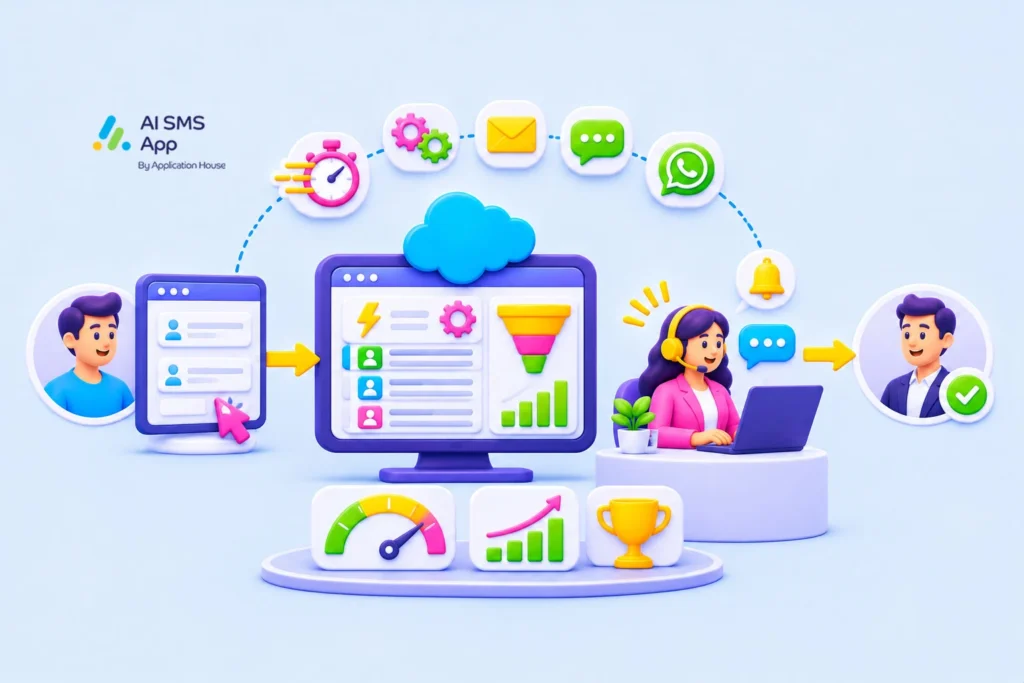
Salesforce is where your leads and sales activity is managed, so by combining your existing CRM processes with automation and SMS or WhatsApp messaging, you can reduce your lead response time.
Some ways to do this are:
1. Automate the initial response
Speed to lead can be improved by automating the first message. When a new lead is created in Salesforce, Flow can trigger an acknowledgment automatically.
This immediate message confirms receipt of the enquiry, then depending on your process, the sales team or an AI agent can follow up or continue the conversation when the prosect replies.
Sending an immediate reply doesn’t mean the prospect is engaged yet – the initial message creates an opportunity for engagement, then the following conversation is where the lead is qualified.
When evaluating your speed to lead, it’s valuable to think about the initial response time (the time from lead creation to first automated message) but also the sales engagement time (the time from lead creation to first meaningful interaction).
2. Improve lead routing or assignment
New leads might need to be assigned to a particular sales rep or team. Distributing leads manually can increase the lead response time, so automating the assignment means new enquiries reach the right person quickly.
Salesforce automation can assign leads based on criteria such as:
- Location
- Product or service interest
- Lead source
- Lead score
3. Prioritise based on buying intent
Some leads have more urgency than others. For example, someone requesting a demo is likely to be closer to purchasing compared to someone downloading a guide.
By using Salesforce lead scoring and automation you can identify high-intent leads, which can be prioritised for immediate follow up, and low-intent leads could enter a nurturing process.
Speed is important but could be wasted on lower intent leads.
4. Use SMS and WhatsApp to reach out
SMS and WhatsApp are a great quick, first method of communication to reach out to leads. Sales teams could use SMS or WhatsApp to:
- Acknowledge receipt of an enquiry
- Ask initial qualification questions
- Arrange a call or demo
- Follow up
When messaging is integrated with Salesforce, the messages are stored on appropriate records, visible, personalised and can be used within existing Salesforce processes.
Use SMS and WhatsApp Improve Your Lead Response Time
Responding to new leads promptly is a key way to improve your sales processes. Salesforce automation can help you to reduce delays by ensuring the new leads are acknowledged and assigned in the best timeframe.
SMS or WhatsApp messages are ideal for the initial contact with leads, so a CRM with text messaging is necessary.
With a Salesforce-native SMS and WhatsApp app, like AI SMS App, you can use messaging and automation together to build an efficient lead management process.
Want to find out more?