Conversational Texting for Business: How Two-Way AI SMS Works
SMS and WhatsApp messages are a great way to send messages to customers or prospects, but conversational business texting can take that one step further. Improving the way you interact with customers will have positive impact on your reputation and customer experience.
Rather than simply sending blasts of information, you can use conversational text messaging to have two-way interactions through a familiar messaging channel.
By using AI agents, you can reply to incoming messages and start conversations at scale, without needing a huge team to handle every interaction.
If you use Salesforce, you can implement conversational texting right into your CRM using a native SMS or WhatsApp app.
In this article, find out what conversational business texting is, how to use it, the benefits it can bring to your business and how to start using conversational SMS and WhatsApp messaging within Salesforce.
What is conversational business texting?
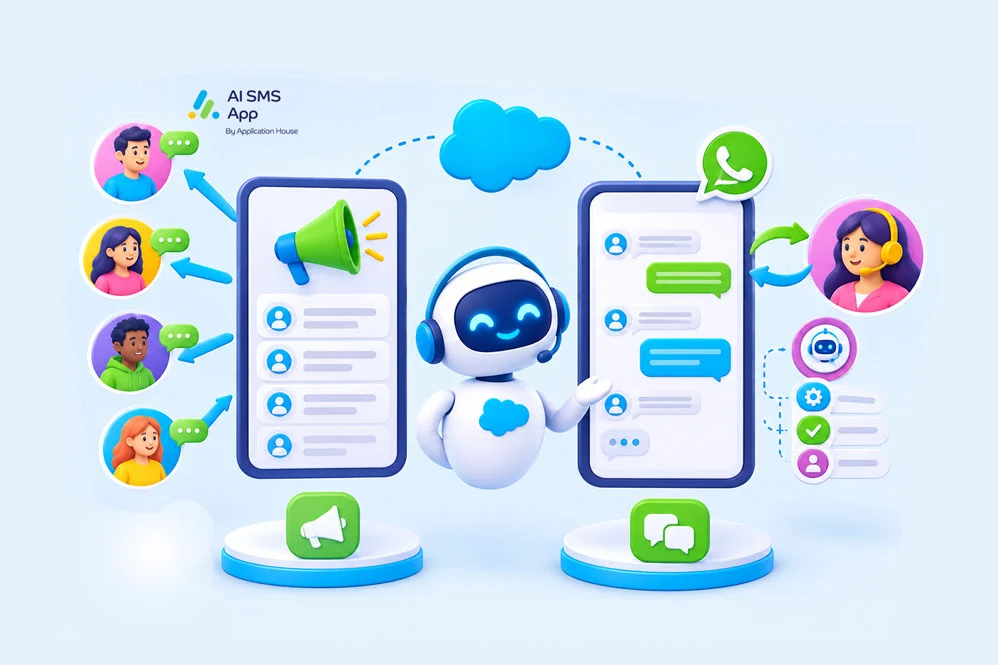
Conversational business texting is essentially two-way communication back and forth between a business and customer or lead via text message (SMS or WhatsApp).
It is more than just sending reminders and promos – it’s talking with customers or prospects and encouraging replies instead of just broadcasting to them.
Conversational business texting can be managed by employees, automated workflows, and AI agents, depending on your set up, the nature of the interaction and size of your team.
Traditional business texting vs conversational business texting
Traditional business texting
- Focus on delivering information to customers
- Automated messages, don’t require a response.
Conversational business texting
- Encourages interaction
- Ask questions, respond according to needs.
Conversational texting vs chatbots
Conversational text messaging has some similarities to a website chatbot.
Chatbots let customers interact with businesses via their website or an app and conversational texting bring similar capabilities to messaging channels that customers already use – it makes it much easier for customers to contact you and respond at a convenient time, without needed to stay connected to the website.
What can conversational text messaging be used for?
Conversational business texting engages customers at all points in journey – capturing leads, qualifying leads, following up, re-engagement, customer support and retention.
Here are some ways each team can use conversational SMS.
Sales and lead generation
Sales teams can use conversational texting to engage prospective customers and move them through the sales process.
- Respond to new enquiries
- Ask qualifying questions [link to lead qualification blog]
- Gain an understanding of customer requirements
- Arrange consultations, meetings or demos
Marketing
Conversational SMS and WhatsApp messaging can make marketing campaigns more interactive.
Instead of sending bulk promotional messages, inviting customers to respond in a conversational way can improve campaign engagement rates.
They can also:
- Collect feedback
- Run surveys [link to SMS surveys blog]
- Re-engage previous customers
Customer service and support
Conversational text messaging is an ideal communication method for customer service teams.
Two-way texting is ideal for:
- Customers asking questions
- Requesting assistance
- Reporting problems
- Receiving updates
Why use conversational business texting?
Using conversational texting can bring several advantages to your business and customers:
Make customer communication convenient
Text messaging provides a convenient alternative to phone calls and emails, allowing customers to read and respond to messages when it suits them.
Personalised interactions
Using conversational text messaging is more personal and can deal with individual customer needs rather than hoping a generic message works.
By having messaging connected to Salesforce, employees and AI agents have access to relevant customer information that provides context for conversations.
Improve response times
Conversational AI SMS texting means your business can respond to incoming enquiries quickly, including outside of normal business hours.
Reduce repetitive admin work
For many businesses, a lot of customer enquiries are routine and require straightforward actions. This is ideal for AI agents to manage, freeing up your teams to handle more complex enquiries.
Conversational texting use cases
There are many industries that are ideal for conversational business texting. SMS and WhatsApp provide a flexible, conversational communication channel for managing bookings, qualifying leads, supporting customers and improving engagement.
Here are some examples of how different industries can use conversational messaging:
Travel and hospitality
For travel agents [link to travel agent SMS blog], hotels and hospitality businesses, conversational texting is a convenient way to communicate with guests before, during and after stay or trip.
Conversational use cases for travel and hospitality:
- Answering booking enquiries
- Understanding travel preferences and requirements
- Providing travel information and updates
- Welcome message offering assistance and check in instructions
- Responding to requests during a stay
- Concierge services such as room service or restaurant bookings
- Post stay or trip feedback
Healthcare
Healthcare organisations can use conversational SMS messaging to make administrative communication accessible and improve patient engagement.
Conversational use cases for healthcare:
- Answering appointment enquiries
- Confirming or rescheduling appointments
- Appointment preparation information
- Sending post appointment follow up care instructions and medication reminders
- Supporting patient recall and reactivation [link to patient recall blog]
Financial services
For financial services businesses, conversational texting can improve communication with customers, and support applications, appointment scheduling and document collection.
Conversational use cases for financial services:
- Responding to service enquiries
- Qualifying prospective customers
- Arranging consultations or meetings
- Collecting documents [link to mortgage docu collection blog]
- Application progress updates
Education
Education institutions can use conversational text messaging with prospective students and families to make communication more accessible.
Admissions teams often manage large volumes of enquiries; conversational AI SMS can help to manage this.
Conversational use cases for education:
- Answering admissions enquiries
- Supporting with applications
- Sharing application updates
- Student service enquiries
- Ongoing student engagement
How to do conversational business texting in Salesforce
If your business already uses Salesforce, adding conversational SMS and WhatsApp messaging can be a natural extension of your existing CRM and automation processes.
By using a Salesforce-native messaging app, like AI SMS App, you can keep all conversations connected to the appropriate record, automate communications and use Agentforce agents to hold conversations.
Choose an app to connect messaging to Salesforce
Firstly, using Salesforce native messaging is key – you can connect communication with the records and processes you already use.
Some things to consider:
- Need ability for two-way conversations, not just outbound messages
- Need to be able to associate incoming messages with relevant records
- Need to see full conversation history
- Identify if a message was sent via a team member or Agentforce agent
AI SMS App allows you to do all these things, find out more
Identify where conversations could add value
Reviewing your existing customer journeys can help you to identify where conversations could improve your customer experience or make a process more efficient.
Some ideas for consideration:
- Could a customer reply to an appointment reminder to reschedule or cancel rather than having to call in?
- Could new leads answer qualifying questions via SMS [link to lead qual blog]
- Could guests request assistance via text message during their stay?
- Could students get advice or information through conversational messaging?
- Could customers request support updates or provide missing information?
Frequent and straightforward interactions are the best ones to start with.
Using Salesforce Flow and Agentforce to automate conversations
Salesforce Flow can trigger messages based on events or actions within Salesforce.
For example, if a new lead is created, a Flow can respond with an initial message, or if a case is closed a Flow could send a message asking for feedback.
Flows can also react to incoming messages that contain a certain word or phrase.
Agentforce can take this automation further by allowing AI agents to manage conversations. You can use existing Agentforce agents or create new ones for specific requirements.
If you deal with huge volumes of incoming messages, you’ll likely need AI to manage two-way conversations – it would be difficult to manually keep up with hundreds of conversations.
Agentforce agent can interpret incoming messages, understand intent, respond to questions and handle the interaction until it’s decided human handoff is necessary – not every conversation can be managed entirely by AI.
Flow and Agentforce lets you build a sophisticated conversational experience, but a clear escalation process should be in place, especially for complex complaints, sensitive healthcare or financial based conversations, anything requiring approval, and for anything the agent is unable to answer.
Measure and improve performance
Once you have set up conversational texting, it’s important to monitor and review how it’s performing.
Depending on your set up, monitoring response times, lead conversion rates, AI resolution rates, customer satisfaction, and conversation volumes can be useful. Use your findings to improve conversation design and refine AI agent behaviour.
Make conversational business texting a business improvement strategy, not just another communication channel.
Choose AI SMS App as a conversational texting solution
If you’re looking to add two-way messaging that helps your customers get answers, complete tasks and engage with your services easily, a Salesforce-native SMS and WhatsApp app is the answer.
With AI SMS App, you can bring conversational text messaging into Salesforce, use your AI agents, and keep employees involved when needed.
Get in touch for a demo to see how it works today.