Hotel Text Messaging: A Guide To Better Guest Communication
Clear communication is an important part of the hotel guest experience. From booking confirmations through to post-stay feedback, there are several points of the customer journey that are perfect for hotel guest text messaging.
With 81% of travelers preferring contactless services, sending a text is a convenient and direct way for guests to stay informed or get support before, during and after their stay.
For hotel groups already using Salesforce, text messaging from a native SMS app can bring guest conversations into CRM records, helping customer service or concierge teams to build great customer relationships.
In this guide, see how hotels can use SMS to communicate with guests, the benefits and best practices of hotel text messaging.
When Should Hotels Text Guests?
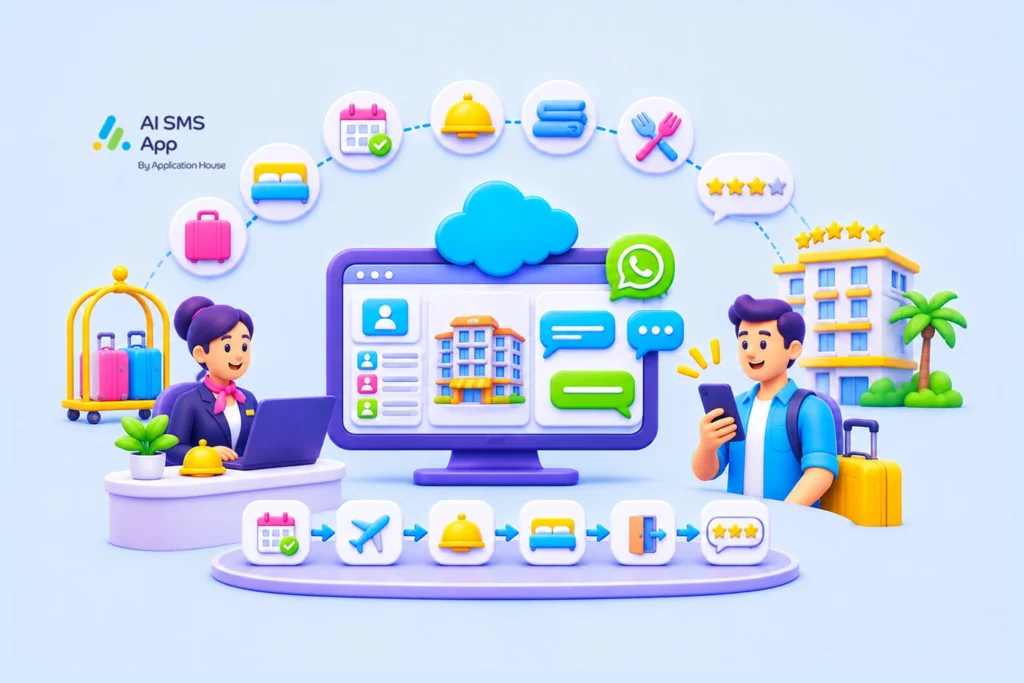
Text messaging can support guests through most points of the customer journey. The following use cases focus specifically on service and operational guest support – for further ideas on promotions and offer text messages check out our blog ‘SMS Marketing for Hotels: Promotions, Offers and Direct Bookings’.
1. Reservation confirmations
A simple confirmation text message can reassure guests their booking has been received.
2. Pre-arrival guest communication
Your guests experience can be improved if they have any practical information before arrival, plus it can cut time spent at the front desk asking questions. Useful information such as exact address, check in time, parking arrangements, late-arrival instructions, or links to complete guest information can be sent via text.
SMS messages could also be used to send room-ready notifications.
3. In stay guest support
Texting is a two-way communication method, so it’s an ideal way for guests to make requests such as extra towels or linen, housekeeping assistance, or restaurant bookings.
Using a Salesforce native SMS app, you can have workflows set up to route the requests appropriately. You could also use hotel text messaging to alert current guests with any unexpected disruptions, such as a temporary facility closure, plus an update when service is back to normal.
4. Check out reminders and information
On departure day, or the evening before, a short text can remind guests of their checkout time and instructions. Messages like this should be helpful and not intrusive – one reminder is enough. 65% of hotel guests prefer app-based check-out over having to go to the front desk, so be sure to offer this as an option.
5. Feedback request
Requesting feedback for your hotel via text can be more successful than email, as often texts are harder to ignore compared to a busy inbox.
This can be done using polls, text-voting, or sending a link to an online questionnaire.
Benefits of Sending Texts To Hotel Guests
- Improve the guest experience
- Make hotel operations more efficient
- Keep guests informed easily throughout their stay
- Offer a convenient, personalised service
Best Practices For Text Messaging For Hotels
Text messages should be short, timely, personalised, actionable, not sent too often, and of course, compliant.
Keep messages short and useful
The purpose of the message should be understood quickly, with key information and a next step (if necessary).
It’s best to avoid sending multiple messages, or filling them with unnecessary details.
Send messages at the right time
Timing is an important consideration for hotel guest text messaging. Pre-arrival messages should be sent early enough to be useful, and check-out instructions with enough time for the guest to prepare for checkout.
Personalise to add value
Personalise messages with CRM data such as guest name, arrival date, and property name, when appropriate.
Easy to act upon
If the text messages invite a response, then these need to be monitored in a reasonable timeframe and routed to the appropriate teams. AI agents can be useful in this situation – key phrases in replies can trigger a set action or response.
Don’t send too many messages
More communication doesn’t mean better communication. Only send messages when there is something useful to say – also consider if the guest will have received the same information in another channel. Monitoring opt-out rates for certain message types can help you identify what’s working and what’s not.
Follow compliance rules
Hotel text messaging only works when you have the right consent in place.
Before sending any messages, make sure your hotel follows the relevant compliance rules. In the US, hotels must comply with the Telephone Consumer Protection Act (TCPA) and Federal Communications Commission (FCC) requirements.
You should:
- Obtain prior written consent – with clear language about message types and frequency.
- Use messages for the purpose expected – agreeing to reservation related updates is not automatically permission for marketing messages.
- Respect opt outs – provide an easy way to opt out and action it straight away.
- Check automation workflows – be sure that scheduled or automated messages check consent prior to sending.
How Can Salesforce Support Hotel Guest Text Messaging
For hotel groups already running on Salesforce, integrating text messaging with your CRM with a native SMS or WhatsApp app means the communications you send out are connected to guest records and workflows that your team already uses.
For example, within Salesforce, you can set up a workflow to send check in details to guests due to arrive the following day. This can also help you to use consistent brand standards across all properties.
Sending messages directly from Salesforce also means that opt-outs are managed within your CRM and aren’t sat in silo, giving one source of truth for consent.
Start Improving Guest Communication With Hotel Text Messaging
Text messages, or WhatsApp messages, give hotels a practical way to keep guests informed, answer questions and coordinate services through a guest journey
Do you want to manage hotel SMS within Salesforce? Get in touch to see how AI SMS App can help your hotel group connect with guests, coordinate conversations and help you deliver a consistent service.